
What Got Me Up the Mountain
Last spring, my dear friend David was diagnosed with cancer and lost his father in the same week. As he grieved and prepared for treatment, he made himself a promise: when he was healthy again, he would climb Mount Kilimanjaro. He called and invited me to join him. Climbing Kili – making it to the top of the highest freestanding mountain above sea level in the world - had been a dream of mine for 30 years, but it had been two decades since I'd hiked at altitude. I was nervous about whether I’d be able to summit, but I said yes.
Leading up to the trip I hiked miles with a weighted backpack, ran up hills to get familiar with being breathless, tested every piece of gear I would take, and slept outside in a sleeping bag on the coldest winter nights.
All of that helped. But what really got me up that mountain was the mental training I've been doing since I started meditating 25 years ago. Mindfulness got me up that mountain.
What Is Cold?
Because Kilimanjaro sits so close to the equator, the eight-day journey begins in a tropical rainforest and ends in arctic conditions. Day one was comfortable. My legs felt strong as we began our ascent. I knew how to dose my electrolytes, my gear was easy to access, my boots were broken in.
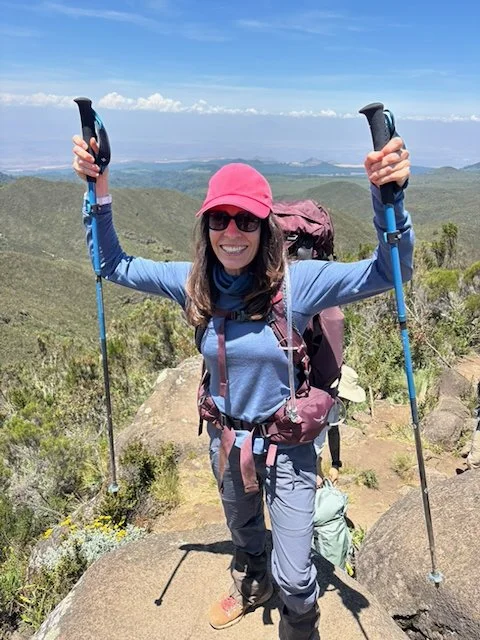
Feeling Strong
Then day two — seven hours of boulders and tricky descents — left me completely wiped out. At dinner, we learned that day two was considered "easy." Doubts crept in about my ability to go the distance - it was only day 2 after all. We had climbed to 11,800 feet of altitude, but still had to make it to 19,300. I knew each step up would take more effort than the last as we got higher. Exhausted from that day’s “easy” trek, I couldn’t stop thinking about how much harder it was going to get.
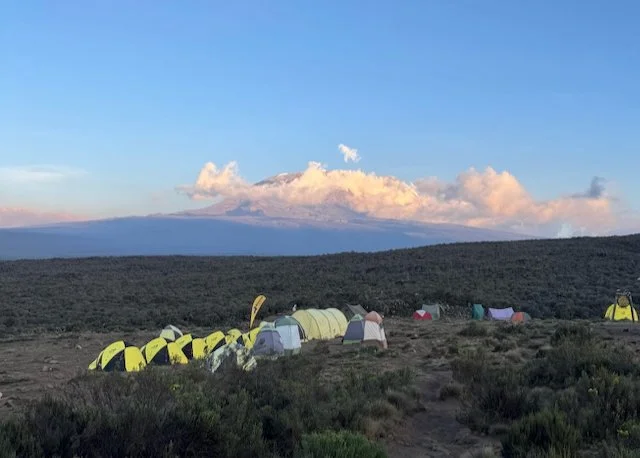
Shira 1 Camp, 11,844 feet of elevation
It was also getting colder.
We’d been roasting under the blazing sun once we’d left the rainforest, but as the sun went down, the temperature began to drop quickly. I added an extra layer before bed, "just in case." An hour later I was shivering. I dug out more clothes, more socks. An hour after that, still cold. I wrapped my feet — by now blocks of ice — in my summit coat, put on my hat and mittens. My mummy bag was zipped to the top, only my eyes and nose exposed. The thought kept looping: This is only day two. There's nowhere to get warm. I have nothing left to put on.
This is where mindfulness kicked in.
Mindfulness lets me catch when I'm stuck in a looping thought — and step back from being inside the thought and shift to watching it, like a news ticker. That awareness cued me to notice what else was happening. I checked in: my chest was tight, my breathing shallow, my jaw locked, my fists clenched. I got curious. What is behind this reaction? I'm reacting as if I'm in peril. Am I in peril? That question — asked with genuine openness, not judgment — gave me room to assess my situation with some equanimity. I knew the sun would rise. Was I likely to die before then? Probably not. And with that settled, I could think practically: Maybe Michelle and I could share a tent for body heat; maybe a porter could bring a warmer sleeping bag at the next resupply point.
Once I had some certainty I'd make it to morning, I asked: What else is going on? I'm really cold. Ok. What is cold? Information — a signal telling me to take care of myself. I'd already extracted everything useful from that signal. So what is it beyond the information? Sensation. Tingling here, a dull ache there. I scanned my body, exploring all the ways I was feeling “cold” in the body. Slowly, by turning towards my discomfort with curiosity, I fell asleep.
When I woke up, frost coated the inside of my tent. It really had been brutally cold. Crawling out into the sunrise, I found my climb-mates doing the same — rubbing their hands, sharing stories of how hard the night had been. I'd felt alone, but we'd all been in it together.
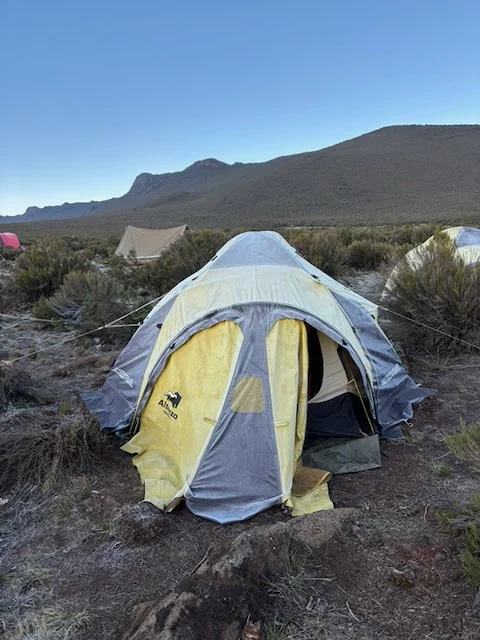
It really had been cold!
The sun, hot tea, and the sense of community warmed me up. I never did need the resupply. I learned to put all my layers on early each evening — and I learned - yet again - how mindfulness can boost my resilience in times of challenge.
Cold was just the beginning. The mountain had harder questions waiting. Stay tuned!
PS. Mindfulness can help us during challenging moments - big and small. Everything from the printer jamming to thinking you’re going to die of cold before dawn. Have you used mindfulness to get you through a tough time? I’d love to hear about it!!